


Blog
Why Chronic Tendinitis Lingers, and How Shockwave Breaks the Cycle

Why Does Tendinitis Turn Into a Problem That Never Fully Goes Away?
Almost everyone with a stubborn tendon tells the same story. It started as a nagging ache after a long hike at Sope Creek or a weekend of yard work. You rested it, iced it, took ibuprofen, and it calmed down. Then it came back, and the next time it came back faster. Six months later you are still stretching every morning and still wondering why something that healed fine the first time now refuses to close the loop. Around East Cobb, this is common among runners on the Chattahoochee trails, tennis players in Marietta leagues, and anyone whose job repeats the same motion a few thousand times a week.
At SoftWave East Cobb, Dr. Paul Drilling, DC works with patients whose tendon pain has outlasted every reasonable at-home attempt to fix it. The therapy he uses, SoftWave TRT, takes a different approach than rest and anti-inflammatories, because by the time a tendon problem becomes chronic, the thing that hurts is usually no longer the thing everyone assumed it was.
Tendinitis and Tendinopathy Are Not the Same Injury
The suffix in tendinitis means inflammation. In a genuinely acute tendon injury, that is what is happening: the tissue has been overloaded, inflammatory cells arrive, the area gets warm and sore, and the body starts its repair sequence. Uncomfortable, but functional.
The problem is that most tendon pain lasting longer than a few months is no longer primarily inflammatory. Researchers examining tissue from long-standing tendon complaints repeatedly find something different from classic inflammation: disorganized collagen, fibers scattered instead of running in neat parallel bundles, changes in the ground substance around them, and abnormal small vessel and nerve ingrowth. That picture is degeneration, and the more accurate name for it is tendinopathy or tendinosis.
This distinction is not academic. It explains why the strategies that worked in month one stop working in month six. You are treating a fire that already burned out while the structural damage it left behind sits untouched.
Why Rest and Anti-Inflammatories Stop Delivering
Anti-inflammatory medication is designed to interrupt an inflammatory cascade. If that cascade has faded and what remains is degenerated collagen, there is much less for the medication to act on. Many patients notice this: the pills that took the edge off early now barely register.
Rest has a similar ceiling. It reduces irritation, which can feel like progress. But tendons respond to load, and taking load away for long stretches tends to leave the tissue weaker and less tolerant, so the return to activity feels like starting over. Rest removed the aggravation; it did not remodel the tissue.
Tendons Have a Blood Supply Problem
Here is the piece that ties it together. Tendon is dense, fibrous, remarkably strong tissue, and it is poorly vascularized compared to muscle. Muscle is threaded with capillaries, part of why a strain often settles in weeks. Tendon has far fewer, and some regions are notably sparse. The Achilles has a well-documented watershed zone a few centimeters above the heel bone. The elbow's common extensor origin, the gluteal tendons at the hip, and the patellar tendon below the kneecap share a version of this limitation.
Blood delivers the oxygen, nutrients, and cellular machinery needed to lay down new collagen and clear damaged tissue. Less blood flow means a slower repair response, which is why a tendon can take months to do what other tissue does in weeks, and why it can stall partway through.
The Partial Healing and Re-Injury Loop
Now picture the cycle that follows. The tendon heals partway. Pain drops enough that you return to your running route or your Saturday doubles match. But the repaired section is not the same quality tissue it was originally. It is thicker in places, weaker in others, and less able to store and release energy efficiently. Load lands unevenly, something tears again, pain returns, you back off, and the tendon heals partway once more on top of tissue already compromised.
Run that loop over a year or two and you get the classic chronic tendon: thickened, tender at a predictable spot, worst for the first ten minutes of activity, quiet during, and angry that evening. The body is not failing to try. It is trying repeatedly and never quite finishing.
If you have been managing the same tendon for longer than you care to admit, it is worth finding out what is actually happening in that tissue. Schedule your visit with SoftWave East Cobb and let Dr. Drilling evaluate whether your situation fits what this therapy addresses.
How SoftWave Is Designed to Restart a Stalled Response
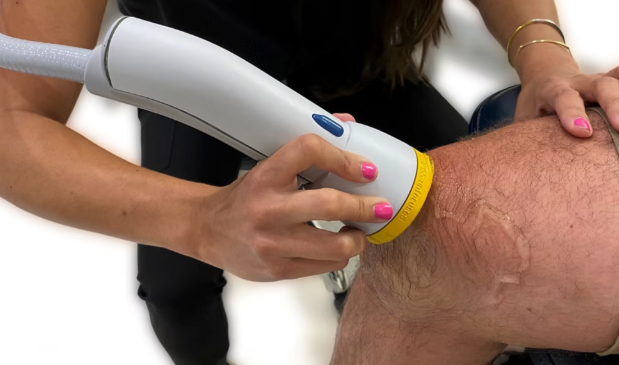
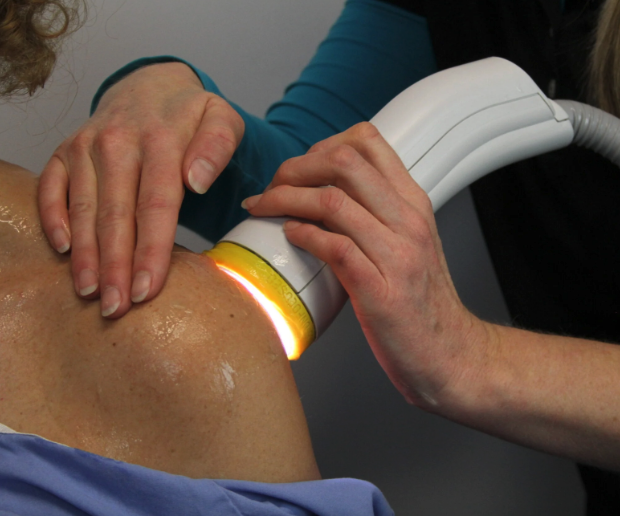
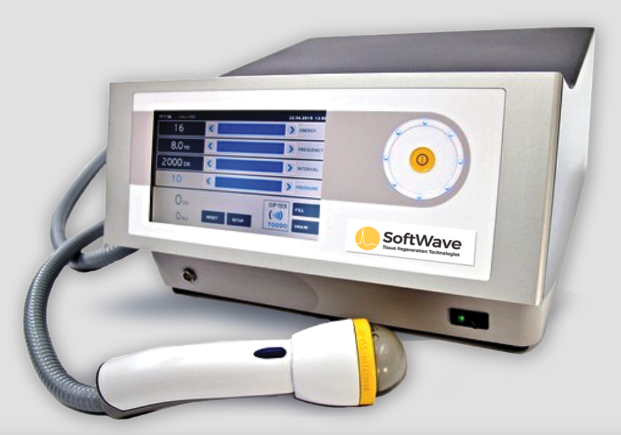
SoftWave TRT uses electrohydraulic, spark-generated acoustic waves directed through a patented parabolic reflector to create a broad-focused wave. That design matters for tendon work. Radial devices disperse energy superficially and unevenly, electromagnetic devices lose energy quickly and lack depth, and piezoelectric devices concentrate energy at a single point, limiting the treatment area. Broad-focused waves cover a meaningful area while still reaching depth, which suits the Achilles, the patellar tendon, the gluteal tendons under the hip, and the forearm tendons at the elbow.
The mechanisms researchers associate with this therapy point at the problems described above:
- Activation and migration of resident stem cells toward the treated area, bringing repair capacity to tissue that had gone quiet.
- Angiogenesis, the formation of new blood vessels, through signaling factors including VEGF and eNOS, addressing the vascularity limitation.
- Cell proliferation and collagen signaling by way of markers such as PCNA and BMP, related to building better organized tissue.
- Modulation of inflammation and regulation of toll-like receptors.
- Clearance of senescent cells, the worn-out cells that linger in degenerated tissue and interfere with repair.
These are researched mechanisms, not promises. No therapy guarantees a result, and this article is not a substitute for an evaluation. What it describes is a strategy built for degenerated, poorly perfused tissue rather than acute swelling, which is the mismatch behind so much chronic tendon frustration. Two of SoftWave's FDA clearances speak to this territory: activation of connective tissue and temporary increase in blood flow.
What Treatment Actually Involves
Sessions are non-invasive: no needles, no drugs, no incisions, and no downtime. A typical session runs roughly ten to fifteen minutes, and most patients are scheduled for a series across about six to eight weeks. Many people describe a tapping sensation over the treated area, then go back to their day.
One expectation worth setting: the biology does not stop when the appointment does. Because the therapy is intended to stimulate the body's own repair processes, changes may continue developing for weeks and months after the final session.
Tendons Commonly Discussed With Patients
- Achilles, especially mid-portion pain that is stiffest on the first steps out of bed.
- Patellar, the jumper's knee pattern below the kneecap on stairs, squats, and landings.
- Gluteal, often felt on the outer hip, mistaken for bursitis, and sore when lying on that side.
- Forearm extensors and flexors at the elbow, aggravated by gripping, lifting, or repetitive keyboard and tool work.
The common thread is not the location. It is the pattern: a tendon that keeps trying to heal, keeps getting interrupted, and needs a reason to start over with real biological support behind it.
Ready to Take the Next Step?
A tendon that has hurt for months is telling you something specific about the state of the tissue, and more rest rarely solves it. Find out whether restarting that stalled healing response is a realistic option for you.
Request your SoftWave Therapy Discovery Day online today
Contact SoftWave East Cobb
SoftWave East Cobb
1000 Johnson Ferry Road, Suite D-100
Marietta, GA 30068
Phone: (404) 775-3988
Office Hours: Monday and Tuesday 9:00am to 2:00pm, Thursday 12:00pm to 6:30pm
‹ Back

 1000 Johnson Ferry Road