
Blog
SoftWave or Surgery? Questions Worth Asking Before You Operate

SoftWave or Surgery? Questions Worth Asking Before You Operate
If you live in East Cobb and you have a surgical consult on the calendar, you are probably somewhere between relief and dread. Relief, because after months of limping around Marietta, someone has finally offered a definite plan. Dread, because surgery is a one-way door.
Surgeons do remarkable work. Some problems genuinely require a scalpel, and no amount of conservative care will change that. But the decision to operate is still a decision, and good decisions come from good questions. At SoftWave East Cobb, Dr. Paul Drilling, DC, works with people who are standing at exactly that fork in the road. Many of them want to know whether there is a non-invasive step worth trying first. SoftWave TRT is often that step: a drug-free, needle-free, incision-free therapy designed to stimulate your body's own repair response.
Here are the questions worth asking your surgeon, and yourself, before you sign the consent form.
Question One: Is My Problem Structural or Soft Tissue?
This is the question that shapes every other answer. A torn ligament hanging by a thread, a shattered bone, an unstable joint, a nerve being physically crushed by a mass: these are structural problems. Something is mechanically wrong, and mechanical problems usually need mechanical solutions. Surgery exists for a reason, and in those cases it is often the fastest and safest route back to a normal life.
But a large share of the pain that sends people to an orthopedic office is not purely structural. Chronic tendon irritation, stubborn plantar fascia pain, nagging shoulder or hip discomfort, and stiff, poorly perfused tissue that simply stopped healing are soft-tissue problems. Ask your surgeon directly: is the imaging finding actually the source of my pain, or is it an incidental finding? Scans routinely show wear and tear in people who have no symptoms at all. If the answer is less certain than you expected, that uncertainty is useful information.
Question Two: What Is the Realistic Recovery, Not the Best Case?
Ask for the honest middle of the range, not the highlight reel. How long until you can drive? Sleep normally? Return to work, to the gym, to carrying groceries up the stairs? Will you need a brace, a boot, crutches, or a sling, and for how many weeks? Is formal physical therapy required afterward, and how many visits does that typically take?
Then add the parts people forget: time off work, help at home, and the deconditioning that comes from weeks of reduced activity. None of this makes surgery wrong. It simply lets you compare options honestly.
Question Three: What Happens If It Does Not Fully Resolve My Pain?
Every surgeon will tell you that outcomes vary, and every honest one will tell you that some patients still have pain afterward. Ask what the plan is in that case. Is there a revision option? What conservative care would you be sent to if the first surgery does not deliver what you hoped?
It is worth noticing that many of the answers to that question are conservative treatments you could have tried beforehand. If a therapy is on the list of things you would do after a disappointing surgical result, it is fair to ask why it is not on the list of things to try first.
Question Four: What Conservative Options Remain Untried?
Make an actual inventory. Rest and activity modification. Anti-inflammatories. Physical therapy done consistently, not two sessions before you gave up. Bracing or orthotics. Injections. Chiropractic care. And regenerative approaches like SoftWave TRT.
Most people discover they tried some of these halfway and others not at all. If several boxes are still unchecked, and the condition is not urgent or unstable, you may have more runway than you thought.
How SoftWave Helps
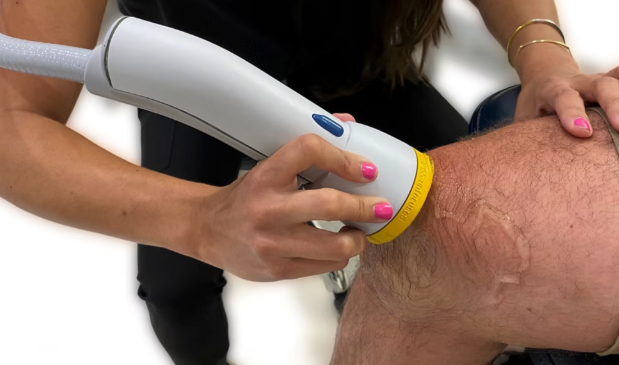
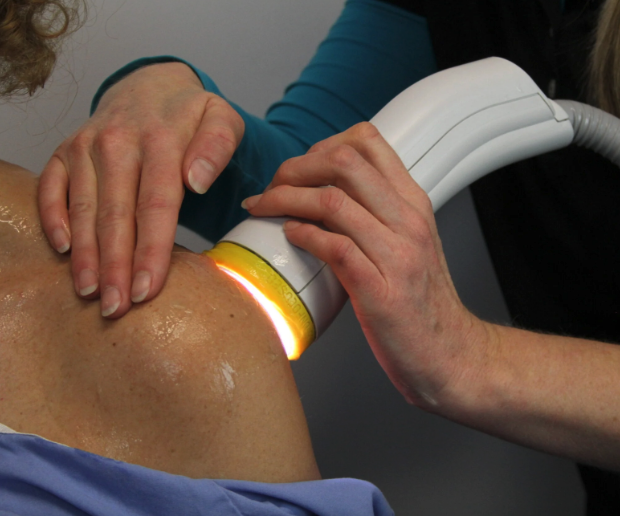
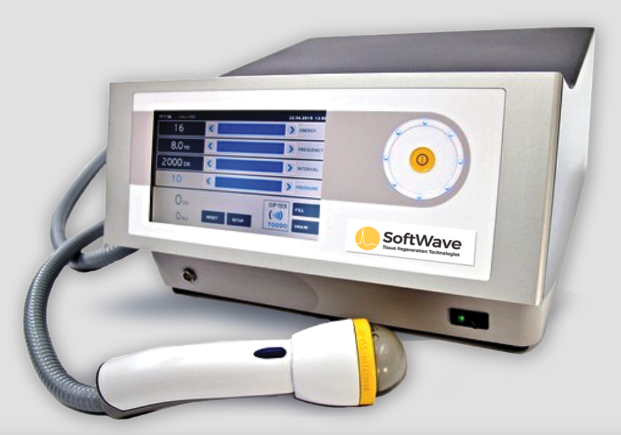
SoftWave TRT uses electrohydraulic, spark-generated acoustic waves delivered through a patented parabolic reflector. That design produces broad-focused shockwaves, which is what separates it from other devices. Radial machines disperse energy superficially and unevenly. Electromagnetic systems lose energy quickly and lack depth. Piezoelectric devices concentrate energy at a single tiny point, which limits how much tissue you can treat. Broad-focused waves are designed to reach deeper tissue across a meaningful treatment area.
What those waves are designed to do once they get there is the interesting part. Researchers have described several biological mechanisms:
- Resident stem cell activation and migration, calling the body's own repair cells toward the treated area.
- Angiogenesis, the growth of new blood vessels, through signaling molecules such as VEGF and eNOS. Poor blood supply is a common reason tissue stops healing.
- Cell proliferation and collagen activity, associated with markers like PCNA and BMP.
- Modulation of inflammation, including regulation of toll-like receptors, which helps shift tissue out of a stalled inflammatory state.
- Clearance of senescent cells, the worn-out cells that linger and interfere with normal repair.
These are researched mechanisms, not promised outcomes. No one can guarantee how any individual will respond. But the logic is straightforward: rather than removing or reconstructing tissue, SoftWave is designed to prompt the body to do its own repair work.
The experience is simple. Sessions typically run about ten to fifteen minutes, with no needles, no medication, no anesthesia, and no downtime, so you can walk out and go back to your day. Most people complete a series over roughly six to eight weeks, and because the therapy works through a biological cascade, healing may continue for weeks or months after the final session. The technology has been studied at leading institutions and is used by clinicians who work with professional and collegiate athletes.
If you have a surgery date pending and you are wondering whether a non-invasive option deserves a look first, schedule a consultation with SoftWave East Cobb and get a straight answer about whether you are a candidate.
Being Clear About What SoftWave Is Not
SoftWave TRT is not a substitute for necessary surgery. If you have a complete tear, a fracture, a joint that is grinding bone on bone, significant instability, an infection, or progressive nerve compression, delay can cost you. In those situations, the responsible answer is to proceed with the procedure your surgeon recommends, and Dr. Drilling will tell you so.
SoftWave also does not replace medical advice. Nothing here is a reason to cancel an appointment or ignore your physician. The goal is not to talk anyone out of surgery. It is to make sure the choice is informed, and that reversible options were genuinely considered before an irreversible one.
A Reasonable Sequence for Many People
- Get the diagnosis, including a clear explanation of what the imaging does and does not prove.
- Ask whether a delay of six to eight weeks carries any real risk. If the answer is no, you have room to try something conservative.
- Complete a SoftWave series and reassess honestly, including function, not just pain scores.
- If you improve, keep going. If you do not, proceed to surgery with the confidence that you left nothing on the table.
That last point matters. Patients who have exhausted conservative care tend to walk into the operating room with less second-guessing and walk out more committed to their rehab.
Ready to Take the Next Step?
Before you commit to an operation, it is worth finding out whether your condition might respond to a non-invasive approach first. A conversation with Dr. Paul Drilling, DC, costs you nothing but an hour, and it may change the questions you bring to your surgeon.
Request your SoftWave Therapy Discovery Day online today
Contact SoftWave East Cobb
SoftWave East Cobb
1000 Johnson Ferry Road, Suite D-100
Marietta, GA 30068
Phone: (404) 775-3988
Office Hours: Monday and Tuesday 9:00am to 2:00pm, Thursday 12:00pm to 6:30pm
‹ Back

 1000 Johnson Ferry Road