
Blog
SoftWave and Physical Therapy: Better Together Than Apart

Why East Cobb Patients Do Not Have to Choose Between SoftWave and Rehab
One of the most common questions we hear from people around Marietta and East Cobb is some version of this: "I am already doing physical therapy. Should I stop that and try SoftWave instead?" The honest answer is almost always no. These two approaches are not competitors. They do different jobs, and when they run alongside each other, each one tends to make the other work better.
At SoftWave East Cobb, Dr. Paul Drilling, DC, works with patients who are already under the care of a physical therapist, a chiropractor, a personal trainer, or an orthopedic specialist. We are not asking anyone to abandon a program that is helping them. SoftWave TRT is designed to address something rehab cannot directly reach: the biological environment inside the tissue itself. Rehab, meanwhile, addresses something SoftWave cannot do: how you actually load, control, and move that tissue once it is capable of responding.
Two Different Jobs, Two Different Layers of the Problem
It helps to think of a stubborn shoulder, knee, or low back problem as having at least two layers.
The first layer is the tissue environment. Chronically irritated tendons, degenerative joints, and old injuries often have poor local blood supply, lingering low-grade inflammation, and a repair response that has stalled out. The body has filed the problem away as unfinished business. No amount of stretching or strengthening speaks directly to that biology.
The second layer is mechanical. Once an area hurts, you start guarding it. Muscles shut down, neighboring joints take over, and the tissue that was already struggling ends up carrying loads it was never designed to carry in that position. Physical therapy exists to untangle exactly this: restoring range of motion, rebuilding strength through a full arc, retraining timing and control, and progressively reloading a region so it can handle real life again.
SoftWave TRT works on the first layer. Physical therapy works on the second. Treat only one and you are solving half of the problem.
Why Pain Relief Without Rehab Often Leads to a Repeat Visit
Plenty of people have lived this cycle. Something calms the pain down, and it feels wonderful for a while. Then, weeks or months later, the same complaint shows up again, sometimes in the same spot and sometimes one link up or down the chain.
The reason is usually straightforward. Pain going away does not automatically restore the strength, endurance, and coordination that eroded while you were hurting. If a hip has been weak for a year, it is still weak on the day the pain stops. Return to yard work, pickleball, or lifting a grandchild without rebuilding that capacity, and the tissue gets overloaded all over again. This is why we encourage patients to keep their rehab program running even during a stretch when they are feeling great. Feeling better is the opportunity to do the work, not the reason to skip it.
Why Rehab on Genuinely Damaged Tissue Can Stall
The reverse situation is just as frustrating and just as common. A patient is diligent. They do their home exercise program, they show up to every appointment, and they still hit a ceiling. Progress plateaus partway, and every attempt to push past it flares things up for days.
When that happens, the limiting factor often is not effort or programming. It is that the tissue itself is not in a state where it can adapt to loading the way healthy tissue does. Trying to strengthen through a region with a poor blood supply and a stalled repair response can feel like trying to build on ground that has not been prepared. This is where addressing the tissue environment first, or at the same time, can change what rehab is able to accomplish.
How SoftWave Helps the Tissue Environment
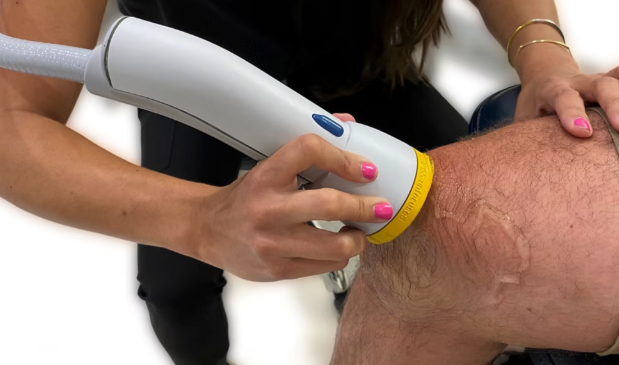
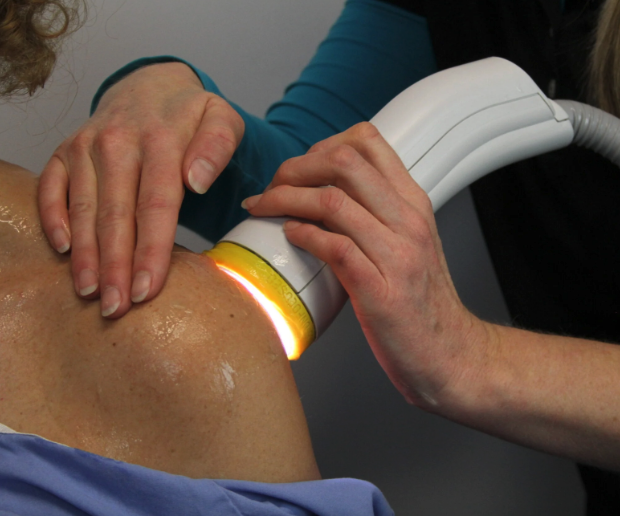
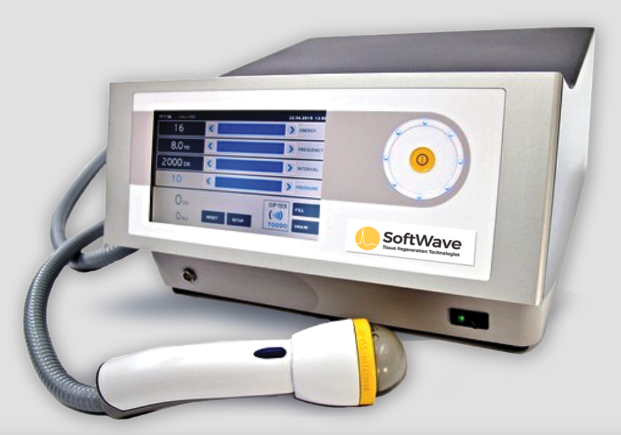
SoftWave TRT uses electrohydraulic, spark-generated acoustic waves delivered through a patented parabolic reflector. That reflector produces a broad-focused wave, which separates SoftWave from radial devices that disperse energy superficially and unevenly, from electromagnetic devices that lose energy quickly and lack depth, and from piezoelectric devices that concentrate energy at a single point and limit the treatment area. The broad-focused wave is designed to reach a meaningful volume of tissue at depth rather than skimming the surface.
Research on this technology points to several mechanisms that may support the body's own repair process:
- Resident stem cell activation and migration: encouraging the body's own repair cells to become active and move toward the treated area.
- Angiogenesis: the formation of new blood vessels through pathways involving VEGF and eNOS, supporting local circulation.
- Cell proliferation and collagen support: signaling associated with PCNA and BMP that relates to tissue building.
- Modulation of inflammation: influencing the chronic low-grade inflammatory state that can keep an area irritated.
- Toll-like receptor regulation and clearance of senescent cells: helping the local environment shift out of a stalled pattern.
These are researched mechanisms, not guaranteed outcomes, and results vary. But they describe work no exercise program is positioned to do on its own.
Sequencing: What Usually Makes Sense
There is no single correct order for everyone, and your providers should weigh in on your specific case. That said, a few patterns come up often.
Running Them Concurrently
This is the most common arrangement. SoftWave sessions typically run about ten to fifteen minutes, involve no needles, drugs, surgery, or downtime, and are usually delivered as a series over roughly six to eight weeks. Because there is no recovery period afterward, you can go from a SoftWave session to a physical therapy appointment the same day. Nothing about the treatment requires you to pause your program.
Leading with SoftWave When Rehab Has Plateaued
If someone has been stuck for months, starting the SoftWave series while dialing rehab back to a tolerable level, then progressing loading as the area responds, can be a sensible approach. Many patients report that they can tolerate more work as the series goes on.
Continuing Rehab After the Series Ends
The healing cascade SoftWave is designed to trigger continues for weeks and even months after the final session. That window is a good time to keep rebuilding capacity so the improvement holds.
If you are already in physical therapy or under chiropractic care in East Cobb and want to know whether SoftWave could complement what you are doing, reach out to schedule a consultation and we will give you a straight answer.
What This Looks Like in Practice
Patients who combine the two often describe a shift in what their rehab sessions feel like. Exercises that used to provoke a flare become manageable. The stiff first thirty minutes of the morning shortens. Progressions that had been stalled start moving again. None of that is promised, and SoftWave is not a cure or a replacement for medical advice from your treating providers. It is one more tool aimed at a part of the problem that has often been left unaddressed.
We are glad to communicate with your existing providers, and we genuinely want you to keep them. A therapist who knows your history and how you move is an asset. Our role is to support the tissue so their work has better material to build with.
Ready to Take the Next Step?
If your rehab has plateaued or you want to give your current therapy program a better foundation to work from, we would be happy to talk through whether SoftWave fits your situation. You do not have to give up anything that is already helping you.
Request your SoftWave Therapy Discovery Day online today
Contact SoftWave East Cobb
SoftWave East Cobb
1000 Johnson Ferry Road, Suite D-100
Marietta, GA 30068
Phone: (404) 775-3988
Office Hours: Monday and Tuesday 9:00am to 2:00pm, Thursday 12:00pm to 6:30pm
‹ Back
 1000 Johnson Ferry Road