


Blog
Is SoftWave Covered by Insurance? What East Cobb Patients Should Know

The Insurance Question Almost Every East Cobb Patient Asks First
When people call about regenerative shockwave therapy, the first question usually is not about the technology or the research. It is about the bill. Will insurance pay for this? It is a fair question, especially for families in East Cobb already carrying deductibles, copays, and the running cost of a stubborn knee, shoulder, hip, or foot problem.
Here is the honest answer, up front: at this time, regenerative shockwave therapy is generally not a covered benefit under most health insurance plans, and it is generally not covered by Medicare either. For nearly all patients, it is an out-of-pocket investment in their own recovery. We would rather tell you that in the first minute of a phone call than let you find out later.
At SoftWave East Cobb, Dr. Paul Drilling, DC, works with patients across Marietta and Cobb County who have already spent significant time and money chasing relief. SoftWave TRT gives them a non-invasive option that works with the body's own repair biology. Understanding how it is paid for is part of deciding whether it belongs in your care plan.
Why Coverage Lags Behind the Technology
It surprises people to learn that a therapy can be FDA-cleared and still sit outside standard insurance coverage. But clearance and reimbursement are different systems, run by different organizations, on very different timelines.
FDA clearance is a regulatory decision about whether a device is safe and appropriate for specific uses. Insurance coverage is a financial decision made separately by each carrier and by Medicare, and it typically arrives years later, if at all. Coverage policies are built around long-established billing codes and treatment categories. Newer regenerative approaches often do not map cleanly onto those older categories, so they get classified as investigational or elective even when the device has been cleared and is in active clinical use.
Coverage also tends to follow whatever is already routine to administer. Established interventions such as anti-inflammatory medications, injections, and surgical procedures have decades of billing infrastructure behind them. A newer, non-invasive technology has to work its way through that system slowly. The lag says a great deal about administrative inertia and comparatively little about clinical value.
What This Means Practically
- Most patients pay directly rather than through a medical benefit.
- There is usually no prior authorization to navigate and no waiting on a carrier's decision before you start.
- Because the care is not dictated by a coverage policy, the treatment plan is built around what your body actually needs rather than what a plan will approve.
- Coverage rules vary widely and do change, so your own plan is always the final authority.
The Cost Comparison Most People Never Run
When patients weigh SoftWave against "doing nothing," the out-of-pocket number can feel like the whole story. But almost nobody with chronic pain is actually doing nothing. They are already spending, month after month, in ways that are easy to overlook because the spending is spread out. Think about what a long-running pain problem typically costs over a year or two:
- Repeat visits and copays. Office visits, follow-ups, and specialist consultations each carry their own charge, and they accumulate quietly.
- Imaging. X-rays, MRI, and ultrasound are often repeated as symptoms persist, and imaging frequently lands against a deductible.
- Medications. Pain relief taken regularly for months or years adds up, and long-term use carries tradeoffs worth discussing with your physician.
- Injections. Injection-based approaches often need to be repeated, and each round means another appointment, another charge, and another recovery window.
- Surgery. Even when a procedure is covered, patients still face deductibles, coinsurance, facility fees, post-operative visits, and rehabilitation.
- Downtime. The cost that never shows up on a statement. Missed work, canceled plans, and the slow narrowing of what you are willing to do with your weekends all have real value.
Set against that cumulative picture, a defined series of sessions with a clear beginning and end looks different than it does in isolation. SoftWave sessions run roughly ten to fifteen minutes over a series of about six to eight weeks, with no needles, no drugs, no incisions, and no recovery downtime. Many patients find the schedule fits around work and family life rather than interrupting it.
How SoftWave Works, in Plain Language
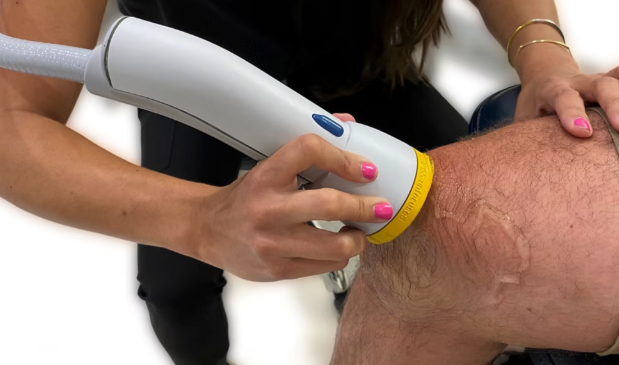
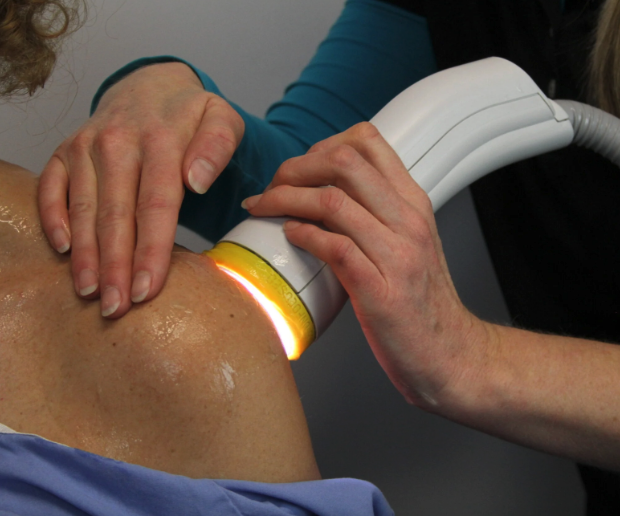
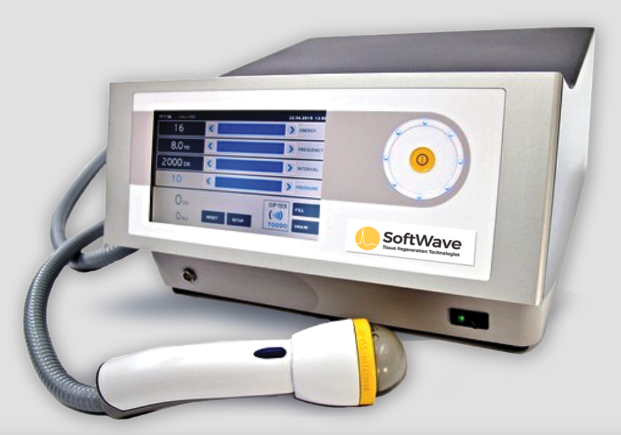
SoftWave TRT uses electrohydraulic, spark-generated broad-focused acoustic waves delivered through a patented parabolic reflector. That design separates it from radial devices, which disperse energy superficially and unevenly, from electromagnetic devices, which lose energy quickly and lack depth, and from piezoelectric devices, which concentrate energy at a single point and limit the treatment area.
The waves travel deep into tissue and are designed to prompt the body's own healing cascade. Researched mechanisms include:
- Activation and migration of the body's resident stem cells toward the treated area.
- Angiogenesis, the formation of new blood vessels, supported by signals such as VEGF and eNOS.
- Cell proliferation and collagen-related activity involving PCNA and BMP.
- Modulation of inflammation and regulation of toll-like receptors.
- Clearance of senescent cells that are no longer contributing to healthy tissue.
These are mechanisms studied at leading institutions, not promises of a specific result. Individual response varies, and no responsible provider will guarantee an outcome. What many patients do report is meaningful change as the series progresses, with the healing response continuing for weeks and months after the final session.
HSA and FSA Dollars May Apply
Even without traditional coverage, many patients have pre-tax funds they forget about. Health savings accounts and flexible spending accounts can often be used for therapies like this, which lowers the real cost using dollars already set aside for health care.
Rules differ by account type and by employer, and FSA funds in particular may carry a use-it-or-lose-it deadline. Confirm eligibility with your own plan administrator before you count on it. We are glad to provide documentation of services rendered for their process.
Wondering how this would work for your situation? The next step is a short conversation. Reach out to our East Cobb office and we will walk you through what a plan of care looks like and what options are available, with no pressure and no surprises.
Questions Worth Asking Before You Decide
Should I still check with my own insurer?
Yes. Coverage policies vary by carrier, employer group, and state, and they do get revised. Calling the member services number on your card costs nothing and gives a definitive answer for your plan.
Is a doctor's referral required?
Because the therapy is generally handled outside the insurance system, most patients do not need a referral to be evaluated. Keeping your primary physician informed about all of your care is still sound practice.
How do I know if I am a candidate?
That is what an evaluation determines. Dr. Drilling will review your history, examine the area, and give you a straight answer about whether SoftWave is a reasonable fit. If it is not the right approach, you deserve to hear that too.
What if I have already tried everything?
Many people who come to our Marietta office have been through injections, medication, physical therapy, or a surgical consultation. A non-invasive option is worth understanding before committing to a more permanent step. This article is educational and is not a substitute for medical advice.
Ready to Take the Next Step?
Cost should be a clear conversation, not a guessing game. Call our East Cobb office and we will explain exactly how payment works, what a full course of care involves, and whether SoftWave makes sense for what you are dealing with.
Request your SoftWave Therapy Discovery Day online today
Contact SoftWave East Cobb
SoftWave East Cobb
1000 Johnson Ferry Road, Suite D-100
Marietta, GA 30068
Phone: (404) 775-3988
Office Hours: Monday and Tuesday 9:00am to 2:00pm, Thursday 12:00pm to 6:30pm
‹ Back



 1000 Johnson Ferry Road