
Blog
How Many SoftWave Sessions Will You Need? A Realistic Treatment Timeline

How Many SoftWave Sessions Will It Take? A Straight Answer About Your Treatment Timeline
Almost every person who calls our East Cobb office asks some version of the same question before booking: how many visits am I signing up for? It is usually the last thing standing between someone and a decision. You have a knee that has ached since last spring, or a shoulder that has quietly reorganized your entire golf swing, and before you commit to anything new you want to know what the commitment looks like on a calendar.
At SoftWave East Cobb, Dr. Paul Drilling, DC, works with patients across Marietta and Cobb County who are trying to avoid injections, medication, or surgery for stubborn musculoskeletal pain. SoftWave Tissue Regeneration Technology (TRT) is the tool he uses to address the tissue itself rather than just quieting the symptom. This article walks through what a realistic timeline looks like, why the number of sessions is different for different people, and how an initial evaluation turns a vague estimate into an actual plan.
The Honest Answer First
No responsible provider can promise you an exact session count over the phone. Anyone who quotes a hard number before laying hands on the area and reviewing your history is guessing, and you deserve better than a guess.
What we can tell you is the shape of the typical plan. Most SoftWave patients complete a series of sessions spread over roughly six to eight weeks, usually attending once or twice a week. Individual sessions are short, generally around ten to fifteen minutes of actual treatment time. That is the framework. Where you land inside it depends on several factors that are worth understanding before you walk in the door.
Why Session Counts Vary So Much From Person to Person
Severity of the Condition
A mildly irritated tendon and a joint that has been compensating for years are not the same problem. The more tissue involved and the more disrupted the local environment, the more stimulation it generally takes to move the needle. Severity is usually the first thing evaluated.
How Long You Have Had It
Chronicity matters as much as severity, sometimes more. A problem that has been present for three months tends to behave differently than one that has been present for nine years. Long-standing conditions often involve poor local circulation, accumulated scar tissue, and a healing response that has essentially gone quiet. Waking that response back up is not instantaneous, and patients with decade-old complaints should plan for a longer runway than someone with a recent flare.
Age and Overall Health
Healing capacity is not identical at 35 and at 75. Circulation, metabolic health, sleep, activity level, and conditions such as diabetes all influence how readily tissue responds. This is not a reason for older patients to opt out. Many patients well into their seventies and eighties report meaningful change. It simply means the timeline conversation should be individualized.
The Type of Tissue Involved
Different tissues have different blood supplies and rates of turnover. Muscle is relatively well perfused. Tendon and ligament are not, which is a large part of why they are notoriously slow to recover. The tissue at the center of your complaint influences both how many sessions are recommended and how quickly you may notice a difference.
What Else Is Going On
Pain is rarely isolated. A hip that hurts may be tied to a back that has been failing quietly for years, and treating one region while ignoring the other tends to produce partial results.
What a Single Session Actually Involves
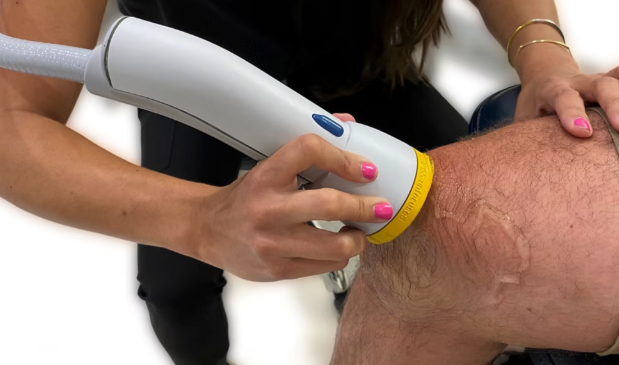
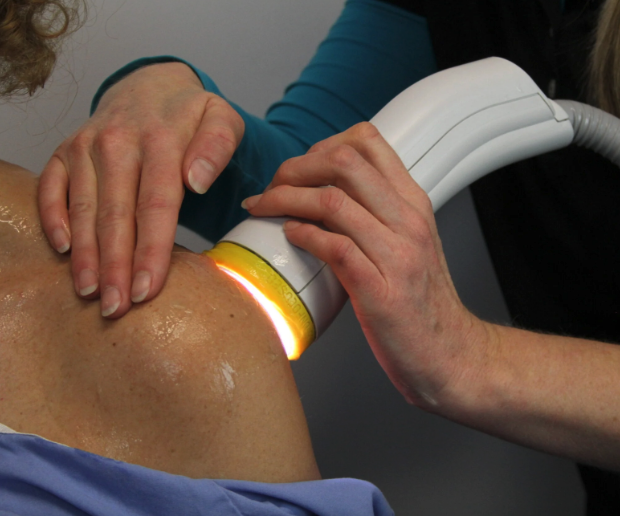
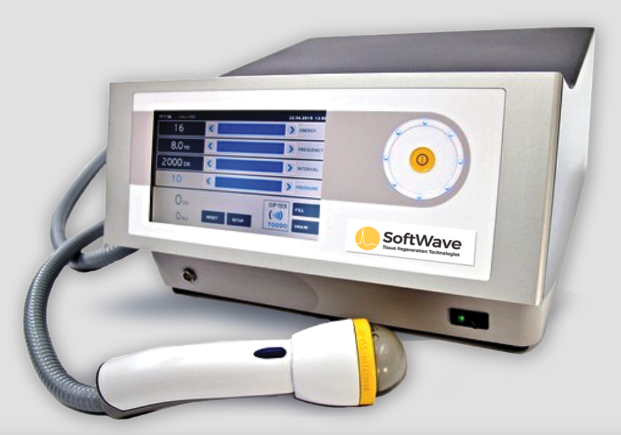
The visit itself is far less dramatic than most people expect. There are no needles, no drugs, no incisions, and no anesthesia. You stay clothed except for exposing the treatment area. A gel is applied so the acoustic waves can transfer efficiently into the tissue, and the applicator is moved over the region while it delivers rapid pulses.
Most people describe the sensation as a firm tapping. Areas that are inflamed or sensitive may feel more pronounced, which is useful information, since the device often finds the problem area before the patient can point to it precisely. Treatment time typically runs ten to fifteen minutes, and there is no downtime afterward. Patients regularly go straight from our office back to work or to the gym.
How SoftWave Is Designed to Work
SoftWave TRT uses electrohydraulic, spark-generated broad-focused acoustic waves delivered through a patented parabolic reflector, and it is the only broad-focused shockwave technology of its kind. Radial devices disperse energy superficially and unevenly, electromagnetic devices lose energy quickly and lack depth, and piezoelectric devices concentrate energy at a single point, which limits the treatment area. The broad-focused design allows meaningful energy to reach a wider volume of tissue at depth.
Researched mechanisms behind that energy delivery include:
- Resident stem cell activation and migration, recruiting the body's own repair cells toward the treated area.
- Angiogenesis, the formation of new blood vessels, supported by signaling molecules such as VEGF and eNOS.
- Cell proliferation and collagen support through markers including PCNA and BMP.
- Modulation of inflammation and regulation of toll-like receptors involved in the healing cascade.
- Clearance of senescent cells, the worn-out cells that clutter chronically damaged tissue.
These are studied mechanisms, not guaranteed outcomes. What they explain is why the timeline works the way it does: you are not masking a signal, you are attempting to restart a biological process, and biology runs on its own schedule.
If you are weighing whether this is worth your time, the most useful next step is simply to get evaluated. Schedule your SoftWave Therapy Discovery Day at our East Cobb office and get a plan built around your situation instead of an average.
Why Healing Continues After Your Last Session
Here is the part that surprises people most. The final session is not the finish line. Because SoftWave is designed to stimulate the body's own repair processes rather than deliver a substance that acts and wears off, the biological response continues well past the end of the series. Many patients report ongoing improvement for weeks and even months after their last visit.
This also explains why progress during a series is rarely a straight line. Some people notice change after two or three visits. Others feel little until the middle of the series and then improve steadily. A slow start is not a verdict, which is why we ask patients to complete the recommended plan before drawing conclusions.
How the Discovery Day Determines Your Plan
The Discovery Day evaluation exists precisely so nobody has to guess. During that visit, Dr. Drilling reviews your history, how long the issue has been present, what you have already tried, and your overall health picture. He examines the area, assesses movement and function, and in many cases demonstrates the technology so you can feel how it responds over the affected tissue.
From there you get a specific recommendation: how many sessions, at what frequency, over what span of weeks, and what a reasonable expectation looks like for your particular case. You also find out if you are not a good candidate. That conversation is far more valuable than a number pulled from a brochure, and it costs you nothing to have it.
Ready to Take the Next Step?
You do not have to commit to a full series to find out whether SoftWave makes sense for you. Start with an evaluation, get a realistic timeline for your condition, and decide from there with actual information in hand.
Request your SoftWave Therapy Discovery Day online today
Contact SoftWave East Cobb
SoftWave East Cobb
1000 Johnson Ferry Road, Suite D-100
Marietta, GA 30068
Phone: (404) 775-3988
Office Hours: Monday and Tuesday 9:00am to 2:00pm, Thursday 12:00pm to 6:30pm
‹ Back


 1000 Johnson Ferry Road