
Blog
Desk Work, Neck Strain, and Shoulder Tension: Relief Without Downtime
Desk Work, Neck Strain, and Shoulder Tension: Relief Without Downtime
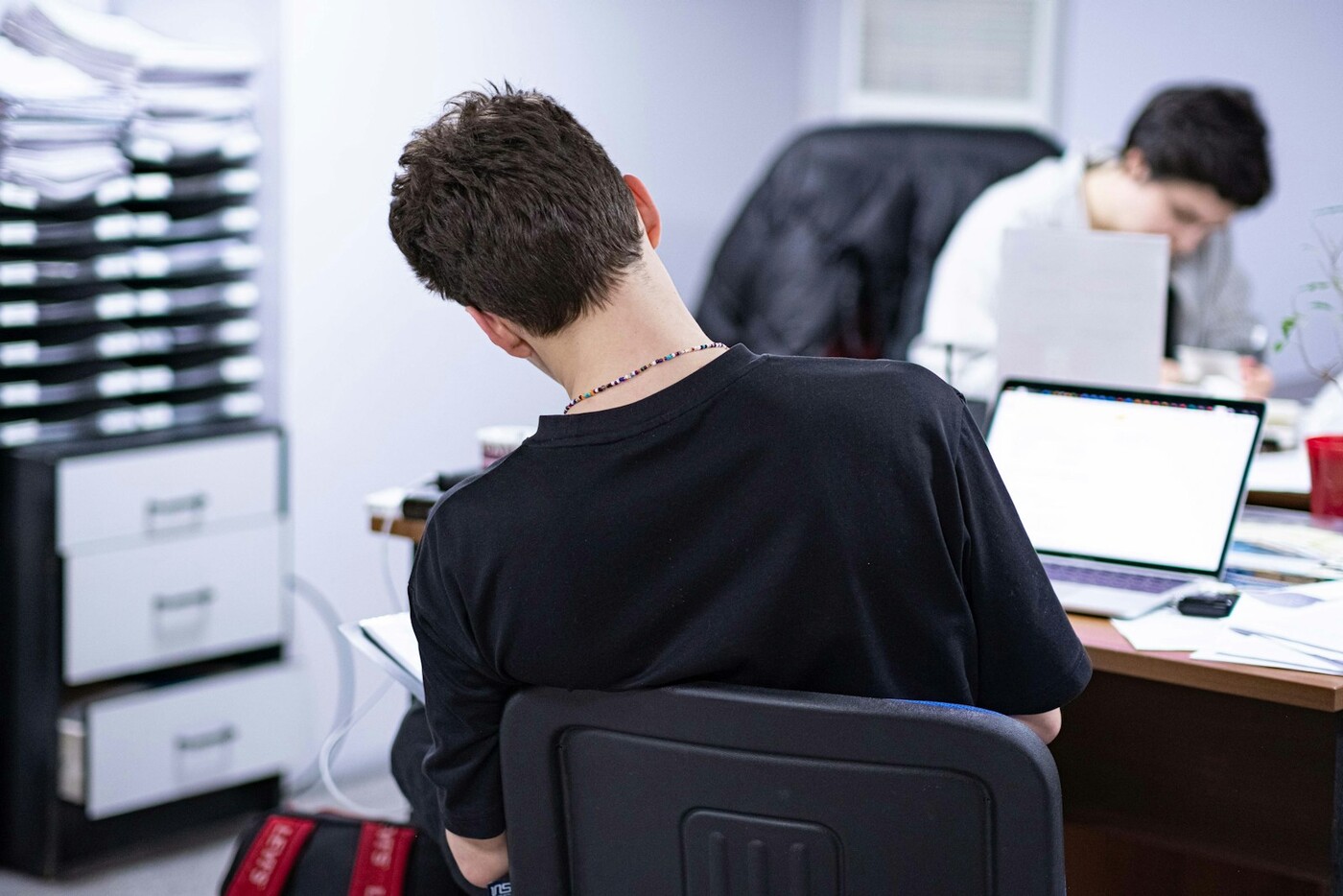
The Atlanta metro runs on desk work. Between the office parks along Powers Ferry and the many East Cobb residents who now work from a converted bedroom, a lot of us spend eight hours a day in the same position. The bill arrives slowly. First a stiff neck on Thursday afternoons. Then a knot between the shoulder blade and the spine that never quite goes away. Eventually a headache at the base of the skull during every long stretch of email.
At SoftWave East Cobb, Dr. Paul Drilling, DC, sees a steady stream of professionals and remote workers whose neck and shoulder complaints did not come from an injury at all. Nothing dramatic happened. The tissue simply absorbed the same low-grade load every workday for years. SoftWave Tissue Regeneration Technology (TRT) is the tool he uses for tissue that has crossed the line from tired into chronically irritated. Before we get there, though, there is real self-help worth doing.
What Sustained Posture Actually Does to the Neck and Shoulders
Forward Head Position
Your head is heavy. Balanced over your shoulders, the deep neck muscles hold it there with very little effort. Shift it a few inches forward toward a monitor, as almost everyone does when reading small text, and the muscles along the back of the neck and upper back must work continuously to keep it from dropping toward your chest. They are built to work in bursts and rest, not to hold an all-day isometric contraction.
Rounded Shoulders and a Closed Chest
Reaching forward for a keyboard and mouse pulls the shoulder blades away from the spine and rolls the shoulders inward. Hold that for years and the chest muscles adaptively shorten while the muscles that retract the shoulder blades become long, weak, and strained. The area that hurts, the band along the upper trapezius and rhomboids, is usually the overworked side, not the tight side. That is one reason massaging the painful spot feels good for an hour and changes nothing by morning.
Static Load and Reduced Blood Flow
This is the piece most people miss. Muscle relies on the pumping action of contraction and relaxation to move blood through it, and a muscle held at low-level tension for hours never gets that pump. Circulation drops, metabolic waste lingers, oxygen delivery falls off. The result is the deep, dull, hard-to-locate ache desk workers describe so consistently: not a strain in the classic sense, but tissue quietly starved of movement.
Why It Becomes Chronic
Under sustained load with poor circulation, soft tissue starts to change. Fascia loses glide between layers, small areas of muscle stay contracted, and the local healing response that would normally clean up minor tissue stress goes sluggish. At that point you are no longer dealing with fatigue a weekend fixes. You have a soft-tissue problem that tends to persist even after you improve your setup.
Practical Changes That Genuinely Help
None of it costs much, and all of it is worth doing regardless.
- Raise the monitor. The top of the screen should sit at or slightly below eye level, about an arm's length away. Laptop users are the worst offenders here, and a stand plus an external keyboard fixes more neck pain than most stretches do.
- Bring the keyboard and mouse closer. Elbows should hang near your sides at about 90 degrees. If you are reaching forward or out to the side, your shoulder works all day.
- Support your forearms. Armrests at the right height, or a desk edge your forearms rest on, takes real load off the upper trapezius.
- Fix the feet and hips. Feet flat, hips at or slightly above knee level. Posture problems often start at the base.
- Move every 30 minutes. Frequency matters more than the movement itself. Stand, walk to the kitchen, roll the shoulders, and put the phone down instead of looking further down at it. Thirty to sixty seconds restores circulation.
- Strengthen the back of the shoulder girdle. Rows, band pull-aparts, and shoulder blade retraction address the weak side rather than the tight side.
Why Stretching Alone Often Falls Short
Stretching feels productive because the relief is immediate, but that relief is largely neurological. You are temporarily changing how the nervous system perceives tension, which is real but short-lived. Stretching does not rebuild the strength deficit that let the posture collapse, and it does little for tissue that has already undergone chronic change. If you have stretched your neck daily for two years and the same spot still hurts, stretching was never the right tool for that layer of the problem.
If your neck and shoulders have kept complaining for months despite a decent workstation and a real effort at stretching, an evaluation is the efficient next move. Schedule your SoftWave Therapy Discovery Day at our East Cobb office and find out what is actually going on in the tissue.
How SoftWave Is Designed to Help Chronically Irritated Tissue
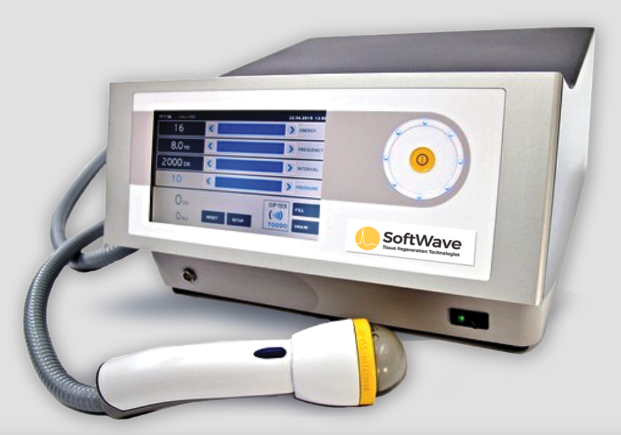
SoftWave TRT delivers electrohydraulic, spark-generated broad-focused acoustic waves through a patented parabolic reflector, the only broad-focused shockwave technology of its kind. Radial devices disperse energy superficially and unevenly, electromagnetic devices lose energy quickly and lack depth, and piezoelectric devices concentrate energy at a single point, limiting the treatment area. For a wide, diffuse region like the upper back and base of the neck, broad-focused delivery matters, because the problem is rarely one pinpoint.
Researched mechanisms behind the technology include:
- Resident stem cell activation and migration, drawing the body's own repair cells toward the treated tissue.
- Angiogenesis, the formation of new blood vessels, supported by signaling molecules such as VEGF and eNOS. This is directly relevant to tissue that has spent years with poor circulation.
- Cell proliferation and collagen support through markers including PCNA and BMP.
- Modulation of inflammation and regulation of toll-like receptors involved in the healing cascade.
- Clearance of senescent cells, the worn-out cells that accumulate in chronically stressed tissue.
These are studied mechanisms rather than promised outcomes, and SoftWave is not a substitute for medical evaluation of neck pain involving numbness, weakness, or radiating symptoms. What they explain is the logic: rather than quieting a signal, the goal is to restart a dormant repair process.
What Treatment Looks Like on a Working Schedule
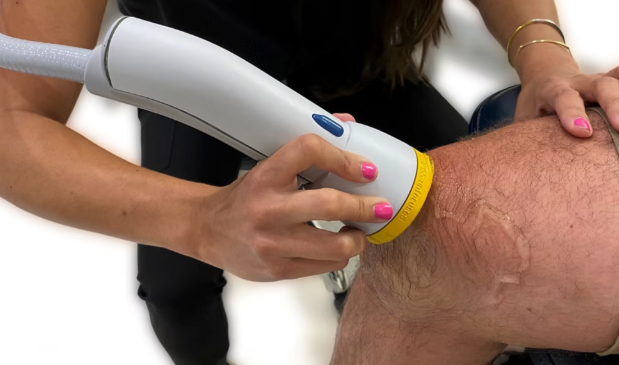
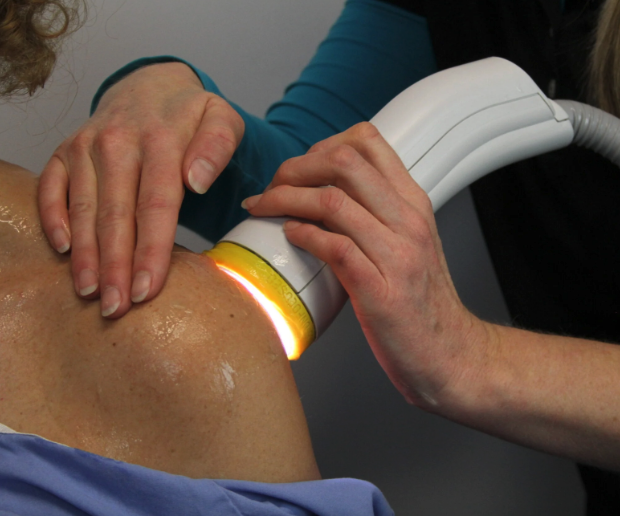
A session involves no needles, no drugs, and no incisions. You stay clothed except for the treated area. Gel is applied so the acoustic waves transfer efficiently, and the applicator moves over the neck, upper back, and shoulder region while delivering rapid pulses. Most people describe it as a firm tapping.
Treatment time typically runs ten to fifteen minutes, with no downtime and no recovery period, so patients routinely go straight back to a laptop, a meeting, or the school pickup line. Most plans run as a series over roughly six to eight weeks, and because SoftWave is designed to stimulate your own biology, many patients report improvement continuing for weeks or months after the final visit. For someone working near Johnson Ferry Road or from a home desk in East Cobb, that fits inside a workday.
The realistic picture is a combination: fix the workstation, build the strength that holds posture without conscious effort, and treat tissue that has already turned chronic.
Ready to Take the Next Step?
Neck and shoulder tension from desk work rarely resolves on its own once it settles in, but it does not have to become permanent. Find out whether the tissue behind your symptoms can be helped before another year of workdays goes by.
Request your SoftWave Therapy Discovery Day online today
Contact SoftWave East Cobb
SoftWave East Cobb
1000 Johnson Ferry Road, Suite D-100
Marietta, GA 30068
Phone: (404) 775-3988
Office Hours: Monday and Tuesday 9:00am to 2:00pm, Thursday 12:00pm to 6:30pm
‹ Back


 1000 Johnson Ferry Road